

4.1.1.1. Attributive possessive pronouns
These elements indicate the person of the possessor within a possessive phrase. In Spanish Sign Language (LSE), some of them are directional. Attributive possessive pronouns are also known as possessive determiners (Rodríguez González, 1992) or possessive adjectives (Herrero Blanco, 2009).
In LSE, one manual realisation of the possessive is the personal pronoun produced with the index finger extended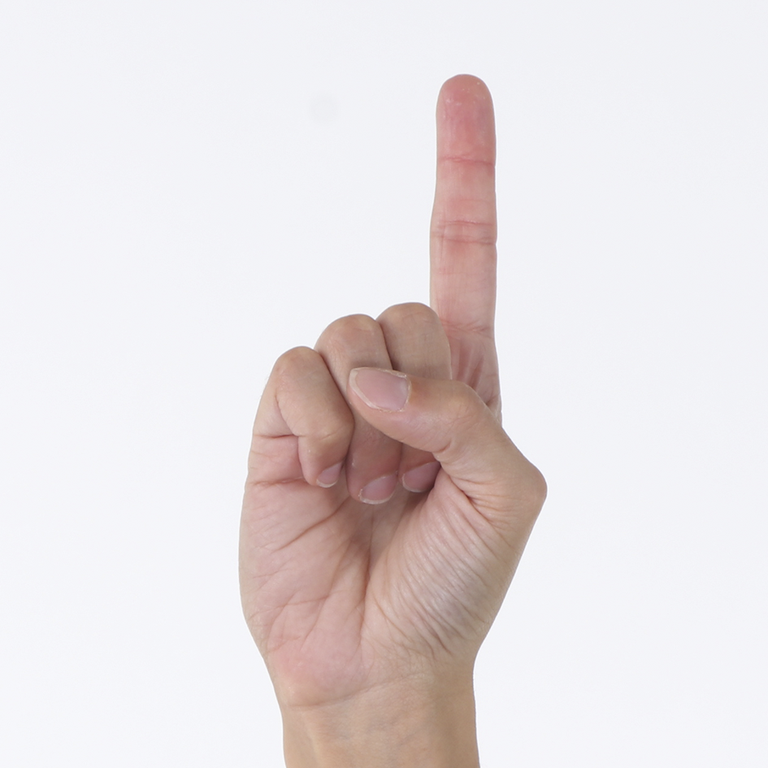 . This form includes a movement directed towards the location associated with the possessor.
In (1), the pronoun in the noun phrase PROI MOTHER is directed towards the possessor I. In (2), the pronoun in the noun phrase PROyou MOTHER is directed towards the possessor you. The sign PRO with a possessive function is typically used when the possessor is a discourse participant. PRO usually precedes the possessum.
Another way to express the possessive in LSE is a sign in which all five fingers are selected together and bent, in a flat, closed configuration (the manual form of the letter Q in the fingerspelling alphabet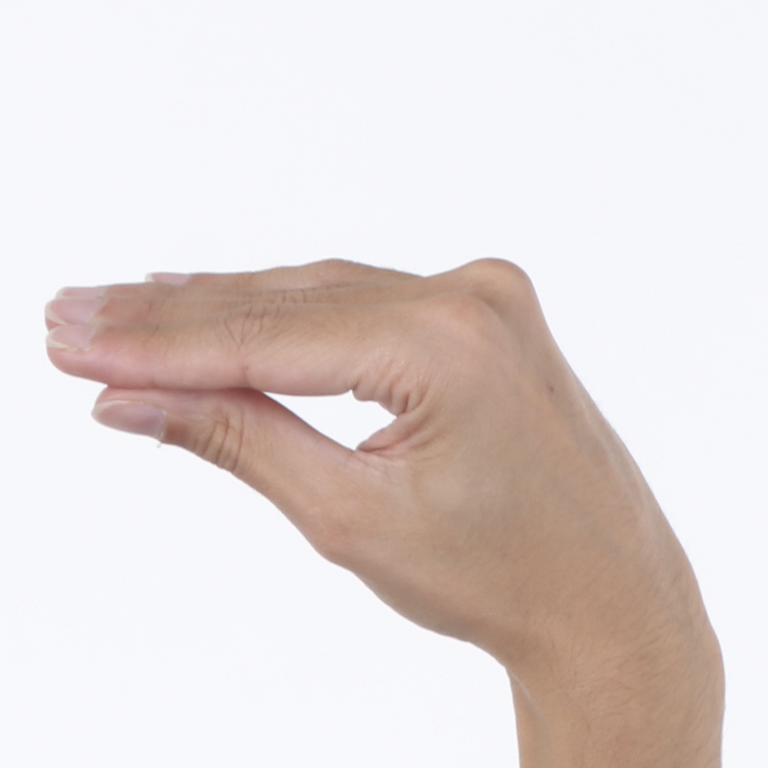 ), as in (3). We will write this using the gloss POS(Q).
In (3), the pronoun in the noun phrase BOOK POS(Q)right is produced with one hand. This possessive can also be produced with both hands, as shown in (4).
The possessive POS(Q) (with one or two hands) is used for the second and third person, not the first.
Another directional form, also not used with the first person, is produced monomanually: all fingers except the thumb are selected, in a flat, open configuration, with the fingers together, and a wrist turn is added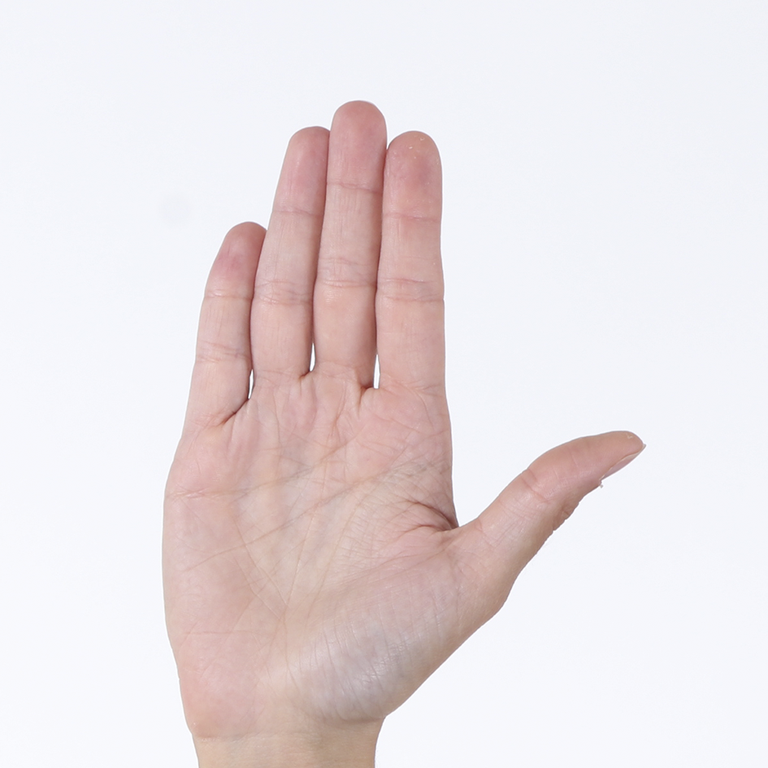 . This is illustrated in (5).
In (5), the possessive in the noun phrase MOTHER POS(4)right is directed towards the possessor, in this case the third person. The form POS(4) is well documented in Madrid. Future research will help delimit the areas and contexts in which this possessive form is used.
For the first person, it is very common in LSE to produce the sign AMO (Herrero Blanco, 2009; Rodríguez González, 1992), for which the glosses OWN or MINE are also used, as in (6).
In (6), in the noun phrase CAR OWN, the sign OWN is articulated on the body and refers to the signer, that is, the first person.
Example (7), taken from CORLSE (APSSC_GR6_CRN_RDR_E2_T3: Childhood anecdotes [anécdotas de la infancia], 36s), shows the possessor sign OWN before the possessum (FATHER^MOTHER).
The sign OWN, accompanied by the personal pronoun, is used with the remaining persons, as illustrated in (8).
In (8), the pronoun in the noun phrase CAR OWN PROleft indicates who owns the car. In these cases, OWN is usually placed after the possessum (here,CAR) and before the pronoun.
A variant of this sign, typically used after the possessum and glossed here as MY, ends its articulation by moving away from the body with a forearm rotation, as in (9).
The form MY is widely documented in Madrid, and future research will clarify whether it is used in other regions and in which contexts.
For the third person, a monomanual sign articulated in the signing space with the fingers extended and together is also used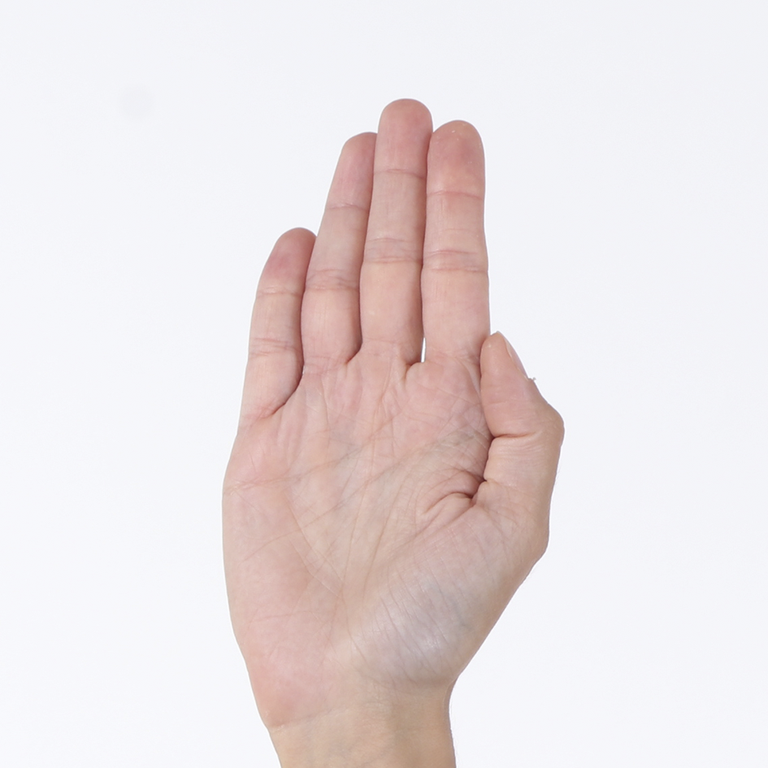 , as in (10).
Villameriel García, S. (2026). Syntax: The noun phrase: Possessive phrases: Ways of expressing the possesive relation in the noun phrase: Attributive possessive pronouns. In S. Villameriel García (Ed.), Gramática de la Lengua de Signos Española (GramLSE) / Grammar of Spanish Sign Language (GramLSE). Real Patronato sobre Discapacidad-Centro de Normalización Lingüística de la Lengua de Signos Española. Retrieved Month DD, YYYY, from https://cnlse.es/es/recursos/gramlse/ingles/index/syntax/chapter-4-the-noun-phrase/4-1-possessive-phrases/4-1-1-ways-of-expressing-the-possesive-relation-in-the-noun-phrase/4-1-1-1-attributive-possessive-pronouns
- Next: 4.1.1.2. Possessive markers
- References
- Spanish sign language and written Spanish version
- Videoglossary (in Spanish sign language and written Spanish)