

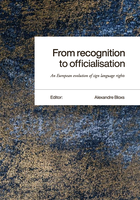
From recognition to officialisation: an European evolution of sign language rights
Temas
Detalles
Over the past four decades, legal and political recognition of national sign languages (NSLs) in Europe has moved from aspirations to concrete realities. Across the European Union, the members of the European Free Trade Association – including Norway, Switzerland and Iceland –, and the UK, NSLs now appear in constitutions, framework laws, education acts and sectoral regulations. This did not happen by accident but is the result of decades of sustained advocacy by deaf communities and their allies. At the same time, the contributions in this volume show clearly that we have reached a new stage. Recognition, on its own, is no longer enough. We need to move from symbolic recognition of NSLs as “languages of their own” towards a more meaningful status: that of official languages, at both EU and national levels. The first part of the book sets out the wider legal and political context in which this shift has to be understood. It places NSLs within the international human rights framework, especially the UN Convention on the Rights of Persons with Disabilities (CRPD) and asks what this means for the linguistic human rights of deaf people. It then looks at the EU’s multilingualism regime, where national sign languages are still rarely treated as part of the European linguistic landscape. A helpful distinction is drawn here between NSLs as full, natural languages – which they all are – and NSLs as official languages. Only a minority of NSLs currently enjoy official status at national level, and none are recognised as official EU languages.